
Explore Local Niche Audit & Pitch Packs with local business audit templates and client pitch templates for local businesses to turn findings into proposals.
✅ 1. What Are Local Niche Audit & Pitch Packs?
- Local Niche Audit & Pitch Packs are designed around a common challenge for freelancers, consultants and small agencies. You can spot something a local business could improve online, but turning that observation into a pitch the owner wants to discuss takes more work.
- The approach starts with a public-facing audit and ends with a practical recommendation. For example, if a salon’s mobile homepage buries its appointment link, you can show the owner where customers have to look and suggest placing the booking button near the top.
✅ 2. Who Can Use Local Business Audit and Pitch Templates?
- Freelance web designers can use an audit to explain where a site’s layout makes it hard to book or enquire. Social media managers can check whether profiles clearly show the business’s services, location and contact options.
- Local SEO consultants and small agencies can use the same process to qualify prospects before committing time to a proposal. Beginners can start with a business they understand and practise explaining one finding in plain language.
✅ 3. What’s Included in the Local Niche Audit & Pitch Packs?
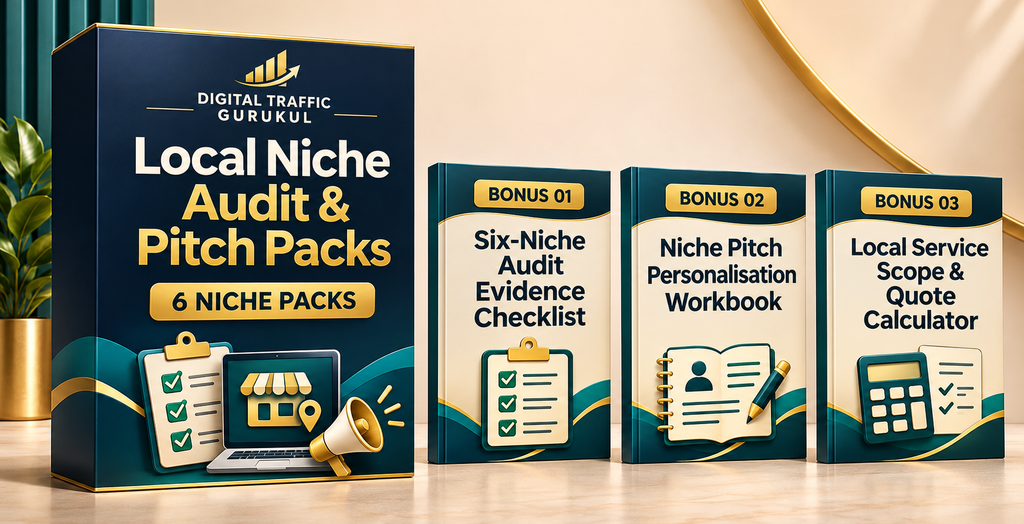
- The workflow covered in this review combines local business audit templates with client pitch templates for local businesses. The audit helps you record and organise findings. The pitch helps you turn a relevant finding into an outreach message or proposal.
- Check the offer page for the exact niches, file formats and editing options. A well-designed niche template should prompt you to check actions that matter to that business, such as requesting a quote from a plumber or booking a class at a fitness studio.
✅ 4. How to Choose a Local Business Niche to Target
- Choose a niche where you understand why customers search and what they want to do next. Someone looking for an electrician may want a phone number and service area. A restaurant customer may want to see the menu, check opening hours or book a table.
- Start with one niche in one location. Reviewing several similar businesses helps you recognise what a typical customer needs and decide which findings are worth raising with an owner.
✅ 5. How to Find Local Businesses to Audit
- Search Google Maps for a service and location, such as “salon in New York City” or “plumber in California.” Open the business profile, website and any social profiles the business links to publicly.
- Record the business name, website and one initial observation. Give priority to businesses where you can verify a specific issue and explain how your service could address it. A prospect list is easier to use when each entry includes a reason for reaching out.
✅ 6. How to Use a Local Business Audit Template
- Record where you checked, what you observed, when you checked it and which customer action it could affect. A page link or screenshot gives you a reference if the owner asks for details or the page changes later.
- Write findings someone else could reproduce. “On mobile, tapping ‘Book Now’ from the services page opens a page that displays an error” gives the owner a specific place to look and gives you a concrete issue to discuss.
✅ 7. How to Audit a Local Business Website on Mobile
- Open the homepage on a phone and try to complete the main customer action. Tap the menu, call button, booking link or enquiry button. Check whether important information is easy to read and whether buttons are easy to reach.
- Follow the full path up to the point where you would submit an enquiry or make a booking. Note how many steps it takes and where the experience breaks down. Record the page and device so you can describe what you observed accurately.
✅ 8. How to Review a Google Business Profile for Local SEO
- Review the public listing for opening hours, contact details, business category and website link. If the profile includes a menu or booking link, open it to make sure it takes visitors to the right page.
- Cross-check key details against the business’s website.If the listing and website show different Saturday hours, note both sets of hours and ask the owner which is current before recommending an update.
✅ 9. How to Review a Local Business’s Social Media Profiles
- Review the profile bio, recent posts and contact options.Check whether someone new to the profile can quickly see what the business does, where it serves customers and how to get in touch. .
- Tap the link in the bio to see which page it opens.For example, a salon might promote appointments in its recent posts while linking to a general homepage. Linking straight to the booking page can help visitors schedule an appointment in fewer steps.
✅ 10. How to Identify and Prioritise Audit Findings
- Rank findings by how directly they affect a customer action, how easy they are to verify and what it would take to fix them. A broken quote request link usually deserves attention before a minor formatting problem on the same page.
- Lead your first pitch with the finding that matters most to the business.
If the owner replies, use the audit notes to explain the supporting details and discuss any other improvements that fit their goals.
✅ 11. How to Turn Audit Findings Into Practical Recommendations
- For each recommendation, explain what you found and what you would change.
. If the enquiry button is hard to find on a mobile service page, suggest adding a clearly labelled button near the service description that opens the existing enquiry form.
- Explain how the proposed change would improve the customer experience.
“Visitors could open the enquiry form directly from the service page” is a benefit the owner can understand and test after the update.
✅ 12. How to Customise Client Pitch Templates for Local Businesses
- Start with a client pitch template and tailor the message to what matters most to the business owner.
Fill in the business name, the page you checked, the issue you observed and the service you can provide.
- Adjust the pitch to match the niche. A fitness studio may care about trial bookings, while a home services business may care about quote requests. Refer to the business’s services using the same wording the owner uses on their website.
✅ 13. How to Write a Personalised Outreach Email
- Open with something specific you noticed and suggest a step the owner can easily take.
For example, “Hi Priya, I was looking at your salon’s services page on my phone and noticed the appointment button opens an error page.Can I send you a screenshot and a quick suggestion for fixing it?”
Use a subject line that matches the message, such as Quick check on your salon booking link. Give the owner enough detail to recognise the issue and reply without having to read a full proposal.
✅ 14. How to Follow Up With a Clear Next Step
- If you receive no response, send a short follow-up that adds a useful detail, such as the page where the issue appears. Offer one action the owner can respond to easily, such as receiving a screenshot or a brief breakdown of the fix.
- If the owner says they already fixed it, acknowledge the update. If the owner asks how you can help, offer a brief call or share a one-page proposal tailored to their needs.
- ✅ 15. How to Turn Your Audit Into a One-Page Client Proposal
- Summarise the verified issue, proposed solution, deliverables, estimated timeline and price. State what you need from the client to complete the work, such as the correct booking link or approval to update the mobile homepage.
- Define how you’ll check the work. If you’re fixing a booking link, for example, include a mobile test confirming that the updated button opens the intended booking page.
✅ 16. Bonuses
Bonus 01:
Six-Niche Audit Evidence Checklist
Identify which details you can verify yourself and which ones you need to confirm with the owner.
Bonus 02:
Niche Pitch Personalisation Workbook
Use one finding you’ve verified to write a message specific to the business.

Bonus 03:
Local Service Scope & Quote Calculator
Estimate labour, direct costs, and contingency in Excel.
17. Final Verdict — Are the Local Niche Audit & Pitch Packs Worth Buying?
- Local Niche Audit & Pitch Packs make the most sense for freelancers, consultants and small agencies that regularly approach local businesses and want a repeatable process. The clearest benefit is having a structure for moving from a verified customer-facing issue to a recommendation and a client conversation.
- Before buying, check whether the available niches match the businesses you serve and whether the formats fit the way you work. If both fit, start with one audit on a prospect you already understand and use it to write a pitch around a single verified finding.
Affiliate disclosure — If you buy through an affiliate link in this article, I may earn a commission.
#LocalNicheAudit#LocalBusinessAudit#LocalBusinessAuditTemplates#ClientPitchTemplates
#LocalSEO#GoogleBusinessProfile#ClientOutreach#LocalBusinessMarketing#